The urban design studio: Staff intentions, student experiences, and lessons learned from Manchester Urban Design Lab, University of Manchester, UK
DOI:
https://doi.org/10.47818/DRArch.2025.v6si195Keywords:
urban, design, studio, applied design, urban designer, educationAbstract
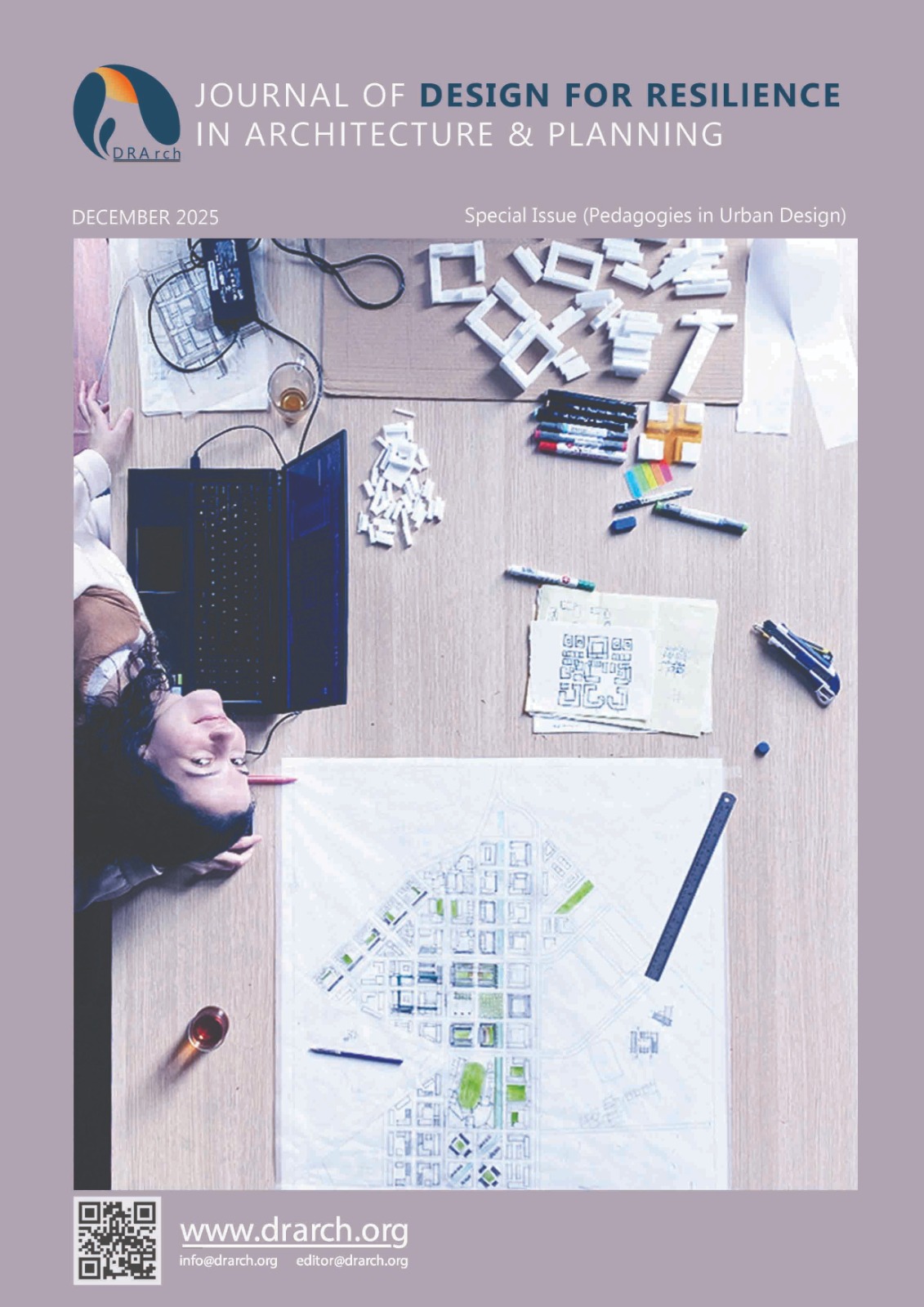
The design studio is the cornerstone of technical applied urban design education – both as a physical space for students to learn within, and pedagogical philosophy for developing and delivering curriculum in higher education settings. A studio-based approach to urban design teaching must reflect the multi-faceted nature of the discipline - a challenge when the current field lacks a consolidated mandate – simulating real-world challenges and contexts and preparing students for the demands of practice. This article explores the pivotal role of the design studio at the University of Manchester (UoM) in shaping future urban designers - emphasizing its contribution to pedagogy, skill development, and nurturing a collaborative and supportive design culture that can extend beyond higher education into professional practice. The studio acts as an interactive and practical laboratory where theoretical knowledge is translated into practical application, where students can experiment, refine ideas, collaborate with peers and tutors, and learn to effectively communicate design visually and orally. The studio-based approach aims to develop technical competencies, cultivate critical thinking, and promote processes that deliver more contextually responsive, people-centered, high quality urban design solutions. The article considers how students (both UK based and international) within the Manchester Urban Design LAB at UoM perceive, and respond to, the studio-based approach during their 1-year dedicated MSc Urban Design program – highlighting their perspective that it instils a positive culture – shaped through the promotion of open dialogue, peer-critique, collective learning, and formative and summative design crits. It is however imperative that these spaces avoid several negative issues that have plagued studio approaches in fields such as architecture in recent years. This brings into focus the role of the academic/tutor in delivering studio that seeks to encourage creativity - where failure is framed as a learning opportunity with a culture of constructive feedback and mentorship at the heart of developing resilience and adaptability in students – as well as developing an appropriate curriculum that maximizes the studio environment. At MUD-Lab/UoM the design studio approach directly shaped, and currently supports, our bespoke framework for practicing urban design (Black et al., 2024) and sits at the very heart of our approach to education.
Downloads
References
Anthony, K. H. (2002). Designing for diversity: Implications for architectural education in the twenty-first century. Journal of Architectural Education, 55(4), 257-267.
Black, P., Martin, M., Phillips, R., & Sonbli, T., (2024). Applied urban design: A contextually responsive approach. Routledge.
Black, P., & Mell, I., (2024). Effective alignment of urban design and landscape: Barriers and successes for education and practice. In M. Roberts & Nelson (Eds.), Research handbook on urban design (pp. 40-55). Edward Elgar Publishing.
Black, P. & Sonbli, T. (2019). The urban design process. Lund Humphries.
Black, P., & Street, E. (2014). The power of perceptions: Exploring the role of urban design in cycling behaviours and healthy ageing. Transportation Research Procedia, 4, 68-79.
Boling, E., Schwier, R. A., Gray, C. M., Smith, K. M., & Campbell, K. (2016) Studio teaching in higher education: Selected design cases. Routledge.
Brown, H. (2022, June 9). The Bartlett School of Architecture environmental investigation. University College London. https://www.ucl.ac.uk/bartlett/sites/bartlett/files/the_bartlett_school_of_architecture_environmental_investigation_report_june_2022p_6.pdf (Accessed date: 03.10.2025)
Crowther, P. (2013). Understanding the signature pedagogy of the design studio and the opportunities for its technological enhancement. Journal of Learning Design, 6(3), 18-28.
Cuff, D. (1992). Architecture: The story of practice. The MIT Press.
Cuthbert, A. (2001). Going global: Reflexivity and contextualism in urban design education. Journal of Urban Design, 6(3), 297-316.
Cuthbert, A. (2007). Urban design: A requiem for an era-review and critique of the last 50 years. Urban Design International, 12, 177-223.
Deamer, P. (2022). Re-producing the status quo. Journal of Architectural Education, 76(2), 189.
DETR & CABE. (2000). By design: Urban design in the planning system: Towards better practice. DETR & CABE.
Ding, D., & Gebel, K., (2012). Built environment, physical activity, and obesity: What have we learned from reviewing the literature? Health and Place, 18(1), 100-105.
Fernando, N. (2007). Decision making in design studios: Old dilemmas-new strategies. In A. M. Salama & Wilkinson (Eds.), Design studio pedagogy: Horizons for the future (pp. 143-152). The International Press.
Fleischmann, K., & Daniel, R. J. (2010). Increasing authenticity through multidisciplinary collaboration in real-life scenarios in digital media design education. CoDesign, 6(2), 61-74.
Goldschmidt, G., Hochman, H., & Dafni, I. (2010). The design studio “crit”: Teacher-student communication. Ai Edam, 24(3), 285-302.
Gropius, W. (1965). The new architecture and the Bauhaus. The MIT Press.
Kamalipour, H., & Peimani, N. (2025). Urban design education: Designing a pedagogy for an evolving field. Edward Elgar.
Kapur, M. (2016). Examining productive failure, productive success, unproductive failure, and unproductive success in learning. Educational Psychologist, 51(2), 289-299.
Llewelyn-Davies, Y. (2000). The urban design compendium. English Partnership.
Madanipour, A., (2006). Roles and challenges of urban design. Journal of Urban Design, 11(2), 173-193.
Natarajan, L., & Short, M. (2023). Engaged urban pedagogy: Participatory practices in planning and placemaking. UCL Press.
Oh, J. E., & Zurlo, F. (2021). The role of technology in reforming design education: Pedagogy, critique, transformation. Cubic Journal, 4(4), 4-15.
Oh, Y., Ishizaki, S., Gross, M. D., & Do, E. Y. L., (2013). A theoretical framework of design critiquing in architecture studios. Design Studies, 34(3), 302-325.
Oliveira, S., Griffin, E., Cash, D., & Marco, E. (2020). Health and wellbeing in design studio briefs-architecture and engineering graduating students’ motivations and approaches. Building Services Engineering Research and Technology. 41(2), 137-152.
Palazzo, D. (2014). Pedagological traditions. In T. Banerjee & A. Loukaitou-Sideris (Eds.), Companion to urban design (pp. 41-52). Routledge.
Pelsmakers, S., Donovan, E., Moseng, K., & Eyebye, B. (2020). Developing architecture studio culture: Peer-to-peer learning. In Education, design and practice – Understanding skills in a complex world. AMPS.
RIBA. (2021). RIBA Studio. https://www.riba.org/learn/become-an-architect/riba-studio/ (Accessed date: 18.07.25).
Romice, O., Rudlin, D., AlWaer, H., Greaves, M., Thwaites, K., & Porta, S. (2022). Setting urban design as a specialised evidence-led, co-ordinated education and practice. Urban Design and Planning, 175(4), 179-198.
Rudlin, D., & Montegue, L. (2019). Why urban design teaching needs an accreditation system. Urban Design, 152, 30-32.
Salama, A. M. (2016). Spatial design education: New directions for pedagogy in architecture and beyond. Routledge.
The Guardian. (2021, June 1). Ex-students complain of sexism and racism at UCL architecture school. https://www.theguardian.com/education/2021/may/31/ex-students-complain-sexism-racism-ucl-architecture-school (Accessed date: 01.09.25)
UDG (Urban Design Group). (2022). Urban design as a career. UDG.
Webster, H. (2008). Architectural education after Schön: Cracks, blurs, boundaries and beyond. Journal for Education in the Built Environment, 3(2), 63-74.
Yavuz Özgür, I., & Çalışkan, O. (2025). Urban design pedagogies: An international perspective. Urban Design International. https://doi.org/10.1057/s41289-025-00271-w
Downloads
Published
Issue
Section
License
Copyright (c) 2025 Philip Black, Rachel Kerr

This work is licensed under a Creative Commons Attribution 4.0 International License.